Product updates
A recording is a promise

Dylan de Heer

Weeve 1.1.9 to 1.2.2: leaving beta, and what had to be true first.
Earlier this month, Weeve left beta. For the first time, we asked people to pay for it.
Free software gets graded on a curve. A rough edge in a beta is a shrug. The moment money changes hands, every rough edge turns into a question: is this worth it? And when the thing you sell is a record of people's conversations, the question sharpens. Can I really trust what this app says was said?
That question shaped everything between 1.1.9 and 1.2.2. This release makes the record trustworthy in three ways: you can check it, you can correct it, and you can keep it.
Why trust, of all things
We spent the spring listening: seventeen panel sessions, sixteen longer interviews, and cold calls with people who downloaded early versions. Two findings set the direction.
First, transcription is rarely the pain. The pain comes after the conversation: condensing what was said, sharing it, reconnecting today's call with what was decided two weeks ago.
Second, privacy is a condition, not a feeling. It is something work imposes. A head of sales at a German software company put it plainly: "I first looked for what is actually GDPR-compliant. Ideally no cloud at all, but that is rare." They did not want to think about privacy. They wanted it settled, so they could think about their sales team.
So the brief wrote itself. Keep every recording on the Mac, so privacy is settled by architecture. Then make the record itself deserve confidence.
You can check it
Until this release, a transcript in Weeve was a wall of text you had to take on faith.
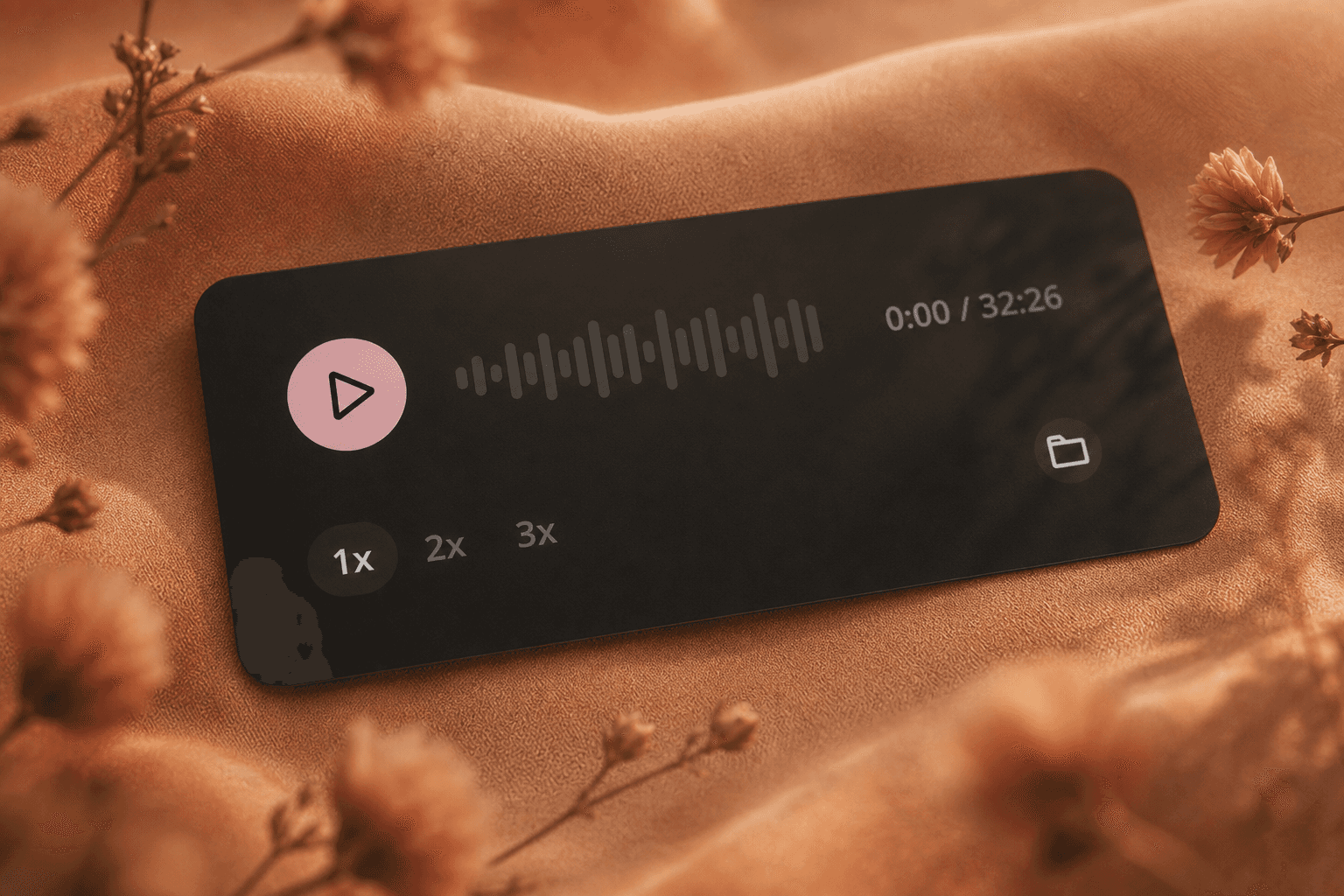
Now every recording has a player. Press play and the transcript follows along, lighting up the exact word being spoken. Click any word and the audio jumps to that second. When someone remembers a conversation differently than you do, you can go back to the moment itself and listen.
On-device models sometimes mishear a word. We would rather hand you the means to catch it than pretend it never happens. A record you can verify is worth more than a record you have to believe.
You can correct it
Every voice used to be Speaker 1 or Speaker 2. You knew who was who. The app had no idea.
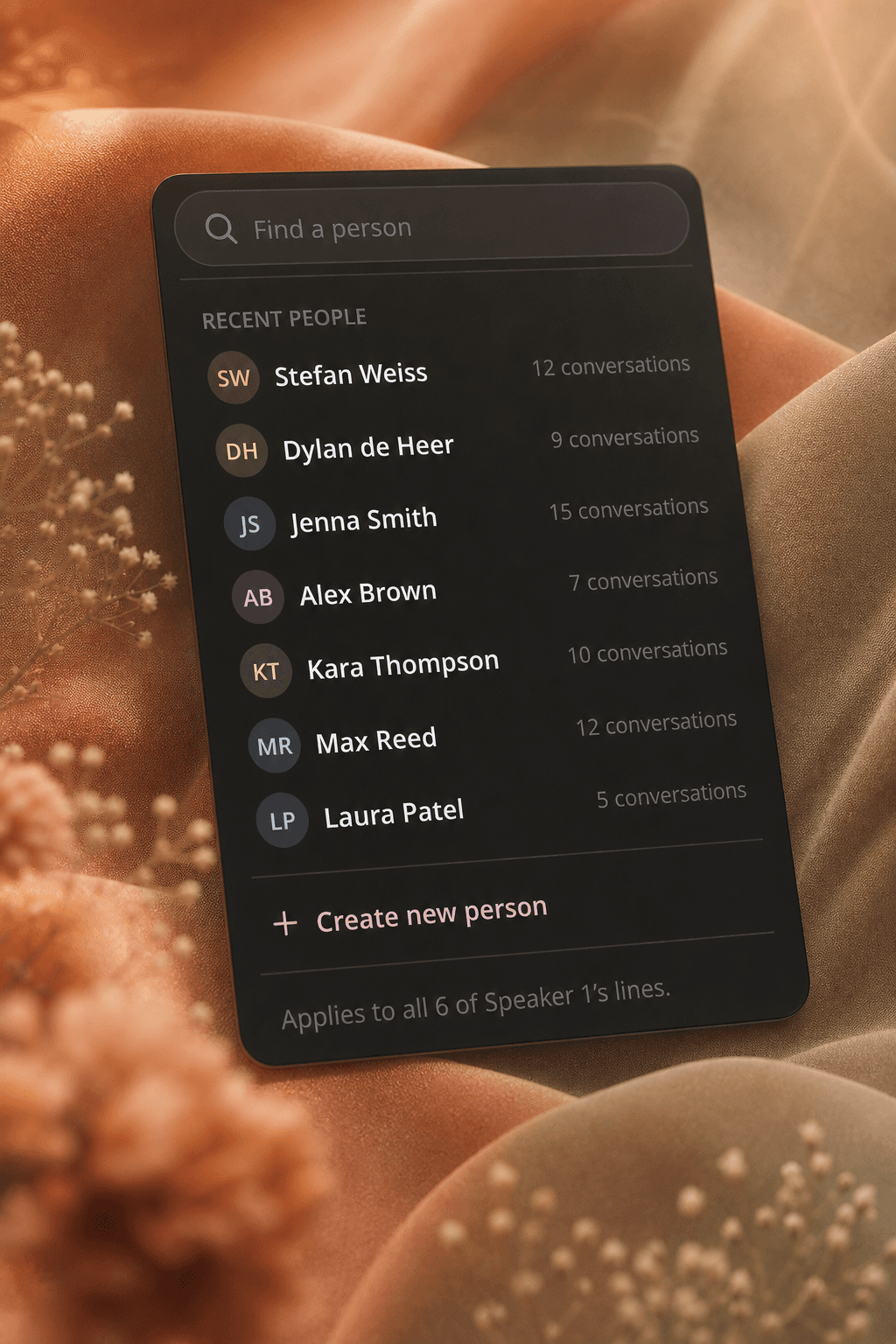
Now there is People. Name a speaker once, and Weeve saves an encrypted sample of that voice on your Mac. The next time the same voice appears, the name is already there. Summaries pick this up too, so decisions get attributed to the person who made them.
And an admission. Counting how many people spoke is the part of our pipeline you write to us about most. At our live session with Xebia this month, an engineer watched Weeve mislabel the room and said it best: "It's not identifying everyone, but those are real people too." He was right.
So the speaker badge above every transcript is now a control. Pick the real number and Weeve re-runs detection on the original audio and relabels who said what. Your words stay untouched. Name two speakers as the same colleague and they merge into one.
We are exploring whether the transcript itself can catch these mistakes automatically. That work is early. A working override today beats a perfect automation someday.
You can keep it
Here is the change I am least proud of needing, and most glad we shipped.
Until this release, a failed transcription deleted the recording. Audio included. A model hiccup after an hour-long conversation could erase the only copy that existed. We built it that way to keep the library clean, and it was the wrong call.
Now a failed transcription keeps everything. The recording stays in your list with a Failed badge, and “Transcribe again” re-runs the pipeline from the saved audio whenever you want. Failure became a delay instead of a loss.
The price
At launch, Free gave you 10 recordings a month and 2 projects. Only conversations of five minutes or longer counted, dictation never counted, and nothing you recorded was taken away when you reached the limit. Pro removed the ceilings for €12,99 a month or €119,99 a year. The principle: an upgrade should follow habit, and nothing should be held hostage. Current Free plan: 10 recordings in total, with no monthly reset. Existing usage carries forward. Only recordings and imports of 5 minutes or longer count; dictation remains unlimited. Upgrade to Pro for further recording after the allowance is used; existing recordings stay available.
Where we are pointed
Our internal name for this work is "recordings that carry context forward." Today a recording arrives knowing who was speaking. The direction is a recording that arrives knowing more: who you are, what you are working on, what was decided the last time you spoke with the people in the room. That is where the research says the real pain lives, and where we want Weeve to earn its keep.
Closer to the ground: speaker detection keeps getting attention, because you keep telling us it deserves it. And Dutch, German, French, and Spanish are first in line for the languages we’ll cover in the interface when we move to a multi-language setup.
No dates on any of this. We plan one quarter in detail and hold the rest as direction, because pretending to certainty we do not have would sit badly in a post about honesty.
Thank you
More than 200 people used Weeve through the beta. You sent logs, sat through interviews, and told us when the speaker count was wrong. A few of you paid before we felt ready to ask. This release exists because of that patience.
A recording is a promise. To yourself, that you will not have to carry the whole conversation in your head. To the people you were with, that the record will be fair. From 1.2.2 on, it is a promise people pay us to keep.
Cheers,
Dylan
Weeve's free Starter plan covers 10 recordings in total on a Mac, with everything written on the device. Apple Silicon and macOS 14.4 or later required. On other machines, the browser recorder captures a call inside the tab and the browser transcriber turns it into text.