Business
How to prepare for a client meeting: turn past conversations into a clear plan

Stefan Weiss

To prepare for a client meeting, decide what the conversation needs to achieve, review the relevant history, check what has changed and choose the questions that will move the work forward. Finish with an agenda the client can influence and a clear way to capture the outcome.
You should be able to explain three things before joining: what is already agreed, what remains uncertain and what you need from this meeting. If those are unclear, another slide is unlikely to solve the problem.
This guide covers first meetings and ongoing client work, with particular attention to the harder case: several previous conversations, changing priorities and commitments that may still be open. The examples are fictional and illustrate the preparation method.
Start with the kind of meeting you actually need
A discovery conversation, a progress review and a decision meeting require different preparation. Calling all three a catch-up hides the work participants need to do.
For a first meeting, prepare a small number of informed questions. Public information can tell you what the organisation does; it cannot tell you which problem the person in front of you wants to solve today. Treat your assumptions as hypotheses to check.
For a progress review, establish the last agreed position and gather current evidence. A previous promise to finish something is not proof that it is finished. Ask the relevant owner for a current update where you need one.
For a decision meeting, identify the options, constraints and person who can authorise the decision. If that person cannot attend, agree whether the meeting should produce a recommendation instead.
For a difficult conversation, prepare the sequence of events and the specific issue to resolve. Separate observed facts from your interpretation of the client's motives. The purpose is to understand the disagreement and choose a next step, not to arrive with a prosecution brief.
Client adviser Andrew Sobel makes a useful distinction in his own preparation guidance: think about the client's perspective and leave room for dialogue, rather than becoming fixed on your presentation. That principle applies whether this is your first conversation or an established relationship. Read Sobel's guidance.
1. Write the outcome before writing the agenda
Write one sentence describing what should be different when the meeting ends. Use an observable result:
Agree which of two pilot options to investigate further.
Confirm the unresolved requirements before estimating the work.
Understand why the client's priorities changed.
Decide who will supply the missing information and when.
“Discuss the project” gives people a topic. “Agree what must be true before we can approve the pilot” gives them work to do.
Do not turn your preferred answer into the meeting's objective. “Convince the client to accept option A” encourages selective preparation. “Assess whether option A meets the agreed constraints” leaves space for evidence that it does not.
Check whether the outcome needs a meeting at all. If it is simply to communicate a settled fact, an update may be enough. If it depends on clarification, negotiation or a decision involving several perspectives, prepare the conversation around that need.
2. Reconstruct the relevant history
Gather the last agreed scope, the latest meaningful correspondence, relevant meeting notes and any authoritative delivery or commercial records. Use recordings when you need to check the wording or context of something that was said.
Do not read the entire account history by default. Start with the question this meeting must answer and choose a sensible period. For a pilot review, that might mean the kickoff and the two subsequent review conversations. For a longstanding disagreement, the original agreement may matter more than the newest update.
Put what you find into three groups:
Agreed: an explicit decision or commitment, with its source and date.
Proposed: an idea someone raised without a clear agreement.
Unknown: information that the available material does not establish.
For example, “We could start with one customer group” is a proposal. “We agreed to start with one customer group” describes a decision. Neither sentence establishes that the pilot has started.
This distinction is also useful when preparing a decision log. For this meeting, keep the history short enough that it helps people act rather than forcing them to reread every conversation.

3. Check what changed after the last conversation
Earlier notes are evidence of an earlier position. Compare them with the current situation before carrying their conclusions into a new meeting.
Look for changes in scope, constraints, participants, dependencies and timing. Then ask which changes are confirmed and which are only suspected. A stakeholder's absence, for example, does not by itself mean they have withdrawn support.
A useful preparation note might say:
The last review agreed a small pilot. The delivery owner has since reported that the required data is not ready. The next meeting needs to decide whether to change the pilot sequence or wait for the data.
That note gives the client something precise to correct. “The pilot is delayed because the client is unprepared” adds a judgement that the evidence may not support.
Where two sources disagree, keep the disagreement visible. Record the dates and ask which position now applies. Do not silently choose the most convenient account or assume that the latest comment overrides a formal agreement.
4. Prepare questions that close the important gaps
Choose questions because of the decisions they enable. A long list can make a meeting feel interrogative and leave little time to explore the most useful answer.
For a first meeting, start with the problem in the client's own words: “What prompted you to look at this now?” Follow with the effect of the problem and what a useful outcome would look like. Avoid diagnosing the solution before you understand the situation.
For an ongoing engagement, tie questions to known context:
“Last time we prioritised onboarding. Is that still the priority, or has something changed?”
“What evidence would let us decide whether the pilot is ready to expand?”
“Which part of the proposed scope remains unclear?”
“Who needs to be involved before this can be agreed?”
For an unresolved commitment, ask about current status without presenting an assumption as a fact: “We recorded that the data would be ready this week. Where does that stand?”
Keep two or three essential questions visible at the top of your notes. Put optional questions underneath. If the conversation reveals a more important issue, use the remaining time to understand it rather than completing the list mechanically.
5. Build an agenda around outcomes and dependencies
An agenda should explain what participants need to contribute. “Pilot” is vague. “Decide whether the current data is sufficient for a limited pilot” is specific.
For a 30-minute review, an illustrative allocation could be five minutes to confirm changes, ten to discuss the unresolved issue, ten to assess options and five to confirm the result. These timings are a planning aid, not a formula. A sensitive or complex decision may need more time or a separate session.
Put dependent items in order. There is little value agreeing a delivery date before the scope is understood. If a missing input prevents a responsible decision, use the meeting to agree how to obtain that input.
Share any material participants must read with enough time for them to respond. Explain what you want them to check. A short note asking someone to verify a requirement is more useful than an unexplained folder of documents.
Invite corrections to the agenda. The client may know about a new constraint you have not seen. Once the meeting starts, confirm that the proposed outcome is still the right one.
6. Use AI to help review conversation history, then check the result
When the context is spread across saved recordings, Weeve's Chat can help you ask questions of that material and inspect the sources behind an answer. The useful role is preparing a draft view of the evidence; you still decide what belongs in the meeting.
Begin with a clear scope. Name the client or project and the relevant period. Ask for decisions, open questions and stated commitments separately. For example:
Review the relevant recordings for this project from the last month. What was explicitly agreed, what remains unresolved, and what should we confirm before the next client meeting? Cite the source for each point. Do not treat promised work as completed work.
Then check the returned scope and any coverage limitation. Open the cited material for consequential claims. If retained audio is available for the passage, listen when wording, speaker attribution or tone changes the interpretation. A fluent answer is not a substitute for the source.
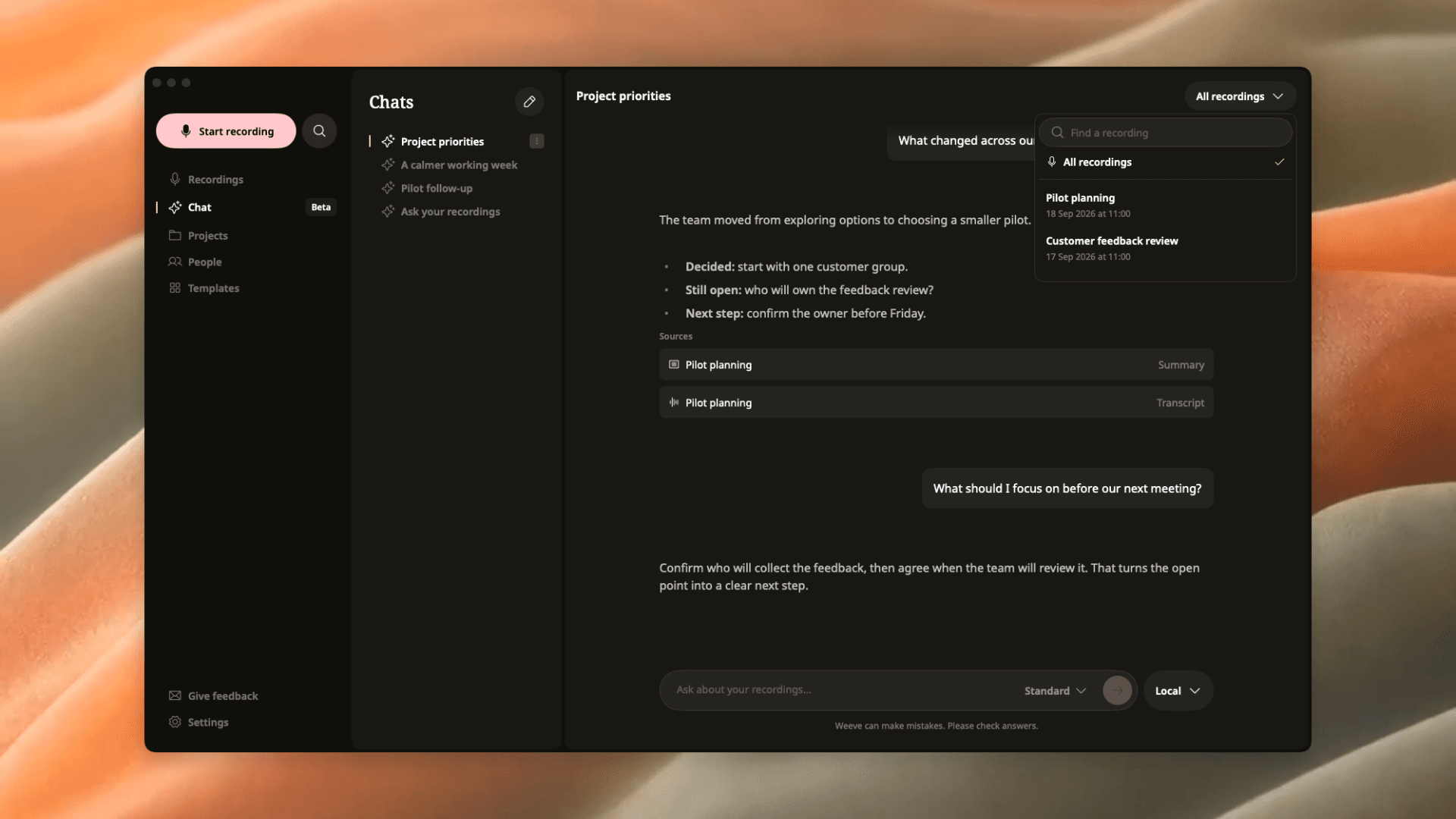
An exported Weeve app capture with demonstration content. The scope control helps distinguish a particular recording from a broader library question.
Weeve can also propose an outline for a follow-up meeting. A proposed agenda is not an agreement, a calendar invitation or evidence that an action was completed. Review and transfer the useful parts into your own preparation notes. The follow-up meeting use case explains that product workflow.
Keep information boundaries in view. Local chat processes locally; choosing an optional external chat provider sends relevant text to that provider. Check the selected provider before using confidential material. The recording library also cannot establish current facts that were never recorded there: delivery status, an amended contract or a newly changed priority may need another source.
7. Prepare the practical details and the close
Check the invitation, time zone, joining link or location, participants and any material you need to show. For an in-person meeting, include travel and access arrangements. For a remote meeting, confirm your audio and screen-sharing setup before the conversation starts.
Agree roles internally if colleagues are joining. Someone should lead, someone should capture the outcome, and everyone should know where their expertise is needed. Avoid bringing extra people without a clear contribution.
If you intend to record, tell participants and follow your organisation's requirements and the permissions applicable to the conversation. Weeve does not obtain consent for you. If recording is inappropriate, use written notes and confirm the important points with the client.
Before joining, reserve space in your notes for decisions, actions, owners and dates. At the close, read back what was agreed and ask for corrections. Where no decision was possible, record the missing input and next step instead of manufacturing consensus. Afterwards, use a concise meeting follow-up email to confirm the shared understanding.
A worked preparation example
Imagine you are preparing a second review of a client's onboarding pilot. The kickoff proposed three customer groups. A later conversation agreed to start with one. The latest review mentioned that the feedback owner was still unconfirmed.
Your preparation should preserve that sequence. The current agreed scope is one group; the earlier three-group idea is background. The unknown is who will collect feedback, not whether someone has already failed to do it.
The meeting outcome could be: confirm the feedback owner and agree what evidence the next review needs. Your essential questions are who can own collection, what information is feasible to gather and when the team can review it. An expansion discussion is premature until those questions are answered.
If the client says the pilot has already changed, update your understanding during the meeting. The preparation did its job by making the old position explicit and easy to correct. It was never meant to prevent the conversation from moving forward.
If you only have ten minutes to prepare
Spend the first few minutes identifying the outcome and reading the last meaningful agreement. Use the remaining time to check the most important change, write your essential questions and confirm logistics. The allocation matters less than protecting those four tasks.
Do not pretend that a quick review is exhaustive. If a consequential fact remains uncertain, say so and make verification part of the meeting. Bring a short, accurate view of what you know, rather than a comprehensive-looking brief built on assumptions.
You are ready when you can enter the conversation with a clear purpose, evidence for the important context and enough openness to learn what has changed.