Business
After-Action Review vs Retrospective: Which Should You Choose?

Stefan Weiss

Choose an after-action review when you want to examine a particular event against what you intended to happen. Choose a retrospective when you want a team to reflect on a period of work and decide how to improve its next cycle. Both can examine success, difficulty and change; the useful distinction is the question you need to answer, not the label on the calendar invitation.
For a delayed customer workshop, you might ask why the actual preparation differed from the plan. For a team that repeatedly struggles to prepare workshops, you might examine workload, coordination and feedback across several weeks. The first question suits an after-action review; the second suits a retrospective. You can use both without holding the same discussion twice.
This guide compares the methods, shows how to choose between them and explains how to carry evidence and actions from one review into the next. The scenarios are fictional examples, not reported customer outcomes.
What an after-action review examines
An after-action review, often shortened to AAR, compares the intended outcome with what occurred, explores the difference and identifies what to repeat or change. Wharton's guidance describes it as a discussion of intention, execution, explanation and adaptation. It recommends reviewing successes as well as failures. Wharton's guide to after-action reviews.
The unit of review can be a workshop, handover, launch, client presentation or another bounded piece of work. “Why did the onboarding handover miss the agreed date?” gives participants a clearer starting point than “Why are our projects difficult?”
Do not assume an AAR must wait for the end of a long project. BetterEvaluation describes reviews at key points as well as at completion, and notes that the format and duration can vary. It also describes a more detailed retrospect as a related variation, which is a reminder that the terminology is not universally separated into rigid categories. BetterEvaluation's method description.
For practical purposes, use the AAR label to signal a concrete question about an event and its execution. Agree the scope at the start so the conversation does not expand into every unresolved organisational issue.
What a retrospective examines
A retrospective gives a team space to look back at how it worked and choose improvements. In a sprint setting, Atlassian describes reviewing what went well, what caused difficulty and what to change for a future sprint. Its playbook moves from feedback to patterns and actions, with owners and deadlines. Atlassian's retrospective guidance.
Outside that setting, a project team can use a retrospective to examine a completed phase or a broader working period. Make that adaptation explicit rather than borrowing every rule associated with a particular delivery framework.
A useful question is: “What should we change about how we prepare and deliver the next set of workshops?” Participants might discuss unclear ownership, late feedback, competing deadlines or practices that made collaboration easier. One dramatic event may be relevant, but it should not automatically define the whole period.
The retrospective is also not a status meeting. Reporting which tasks are finished does not answer what the team should learn about its way of working. Bring status information only when it helps explain an issue the group can examine.
The practical differences that help you decide
The following distinctions are a working guide, not a universal standard. Teams use these terms differently, and the methods overlap.
Start with the scope
An AAR usually benefits from a bounded event with a recognisable intention and actual result. A retrospective can begin with a period of teamwork and look for patterns within it.
If you cannot describe the event clearly, an AAR may drift. If you cannot describe the period or team under review, a retrospective may become a general complaints session. Neither label solves an unclear scope.
Match the evidence to the question
For an AAR, collect the relevant plan, agreed expectations, sequence of events and observed outcome. These let you compare what people thought would happen with what happened.
For a retrospective, include examples from across the period. A single recording may capture one useful discussion while missing quieter successes or recurring friction elsewhere. Look for more than the most recent or memorable example.
Treat participants' accounts as perspectives that may need reconciliation. A transcript can establish that someone raised a concern; it may not establish the underlying cause of the problem. A schedule can show a late milestone without explaining why it was late.
Decide what the output must enable
An AAR might produce a change to how the next event is prepared or executed. A retrospective might produce a short experiment in how the team collaborates during the next cycle.
Both outputs should be specific enough to act on. “Improve communication” is not a usable decision. “Name one reviewer before scheduling the next workshop and ask that person to confirm the brief” identifies an observable change.
The method does not automatically make the action correct. Check whether the proposed change addresses the explanation the group actually discussed, and whether the people responsible can carry it out.
Choose an after-action review for an event you can reconstruct
Imagine a team ran a customer workshop and sent the preparation material later than planned. The workshop still happened, but the facilitators had to spend the opening session explaining information participants should have received beforehand.
An AAR could compare the intended preparation sequence with the actual sequence. It might reveal that the material was ready but nobody knew who could approve sending it. That is a hypothesis to check against the messages and the people involved, not a conclusion to insert before the discussion.
If the evidence supports that explanation, the next action might be to name an approver when the workshop is booked. If the evidence instead shows that the material was incomplete, a different change is needed. Reconstructing the event prevents a convenient explanation from becoming the action by default.
Use this approach when there is a specific event to understand and a next occasion where the learning can be applied. Review a success too: if preparation worked unusually well, identify what made it repeatable rather than assuming it will happen again.
Choose a retrospective for a pattern in how the team works
Now imagine that several workshops have felt rushed, even though they had different facilitators and different approval arrangements. Reviewing only the latest workshop could miss the shared issue.
A retrospective could examine the period as a whole. The team might compare examples, ask when preparation time became scarce and discuss how workshop work competed with other commitments. Participants may disagree about the pattern; record that disagreement and identify what would clarify it.
The outcome could be an experiment: reserve a preparation block before accepting the next workshop date, then review whether the block was used and what interrupted it. This is a proposed test, not a guaranteed solution.
Choose a retrospective when the central question concerns recurring teamwork, habits or conditions across a period. Keep it close enough to the team's actual work that people can contribute concrete examples.
When using both makes sense
Use an AAR to understand an individual event, then bring only the relevant learning into the next retrospective. The retrospective can ask whether that finding is isolated, repeated or connected to a broader working practice.
For example, the workshop AAR might record an unclear approval handover. A later retrospective could compare that finding with similar handovers elsewhere. The team should not simply repeat the entire workshop discussion or treat three mentions of the same incident as three independent examples.
Maintain a clear distinction between a source event and a theme. Give each theme pointers to the events that support it. If the evidence comes from one event, say so.
A useful reason to combine the methods is that they answer different questions. An unhelpful reason is that both meetings already exist in the calendar. If two sessions would examine the same evidence with the same people to make the same decision, consolidate the work.
Turn the discussion into one testable improvement
Before closing either review, make the selected improvement concrete. Describe what will change, who will coordinate it, when it will be tried and what the team will inspect afterwards.

For the fictional workshop example, the improvement could read: “For the next workshop, the organiser names the preparation-material approver when confirming the date. At the next review, check whether the approver was named and whether any approval delay remained.”
This wording separates implementation from effectiveness. Naming an approver proves the change was attempted; it does not by itself prove preparation improved. Look at both when you review the experiment.
Keep the initial set small enough to follow through. A long list can be valuable as a record of ideas, but distinguish that list from the changes the team has actually chosen to try. When someone has not accepted ownership, record the assignment as unresolved.
For a reusable document to capture the resulting learning, see our lessons-learned template. The template records the output; it does not replace the discussion needed to reach it.
Where recordings and AI can help
If the team agrees to record a review and the material is appropriate to retain, a transcript can help you revisit the wording behind a finding. Notes and recordings are supporting evidence; they should not become an excuse to stop asking people whether the draft reflects what they meant.
In Weeve, start with the relevant recording or a deliberately chosen project scope. Ask for the intended outcome, reported events, competing explanations and proposed changes as separate sections. Request source references where available and make the model identify gaps rather than complete the story.
For a retrospective spanning several discussions, specify which recordings and time period to examine. Check which sources the answer actually used. A response drawn from part of a library should not be presented as a complete review of the period.
Then review the draft with the people involved. Keep a proposed action distinct from an agreed action, and preserve uncertainty where the evidence does not establish a cause. Store the final assignments in the system your team uses to manage work; a generated note is not proof that somebody has accepted a task or completed it.
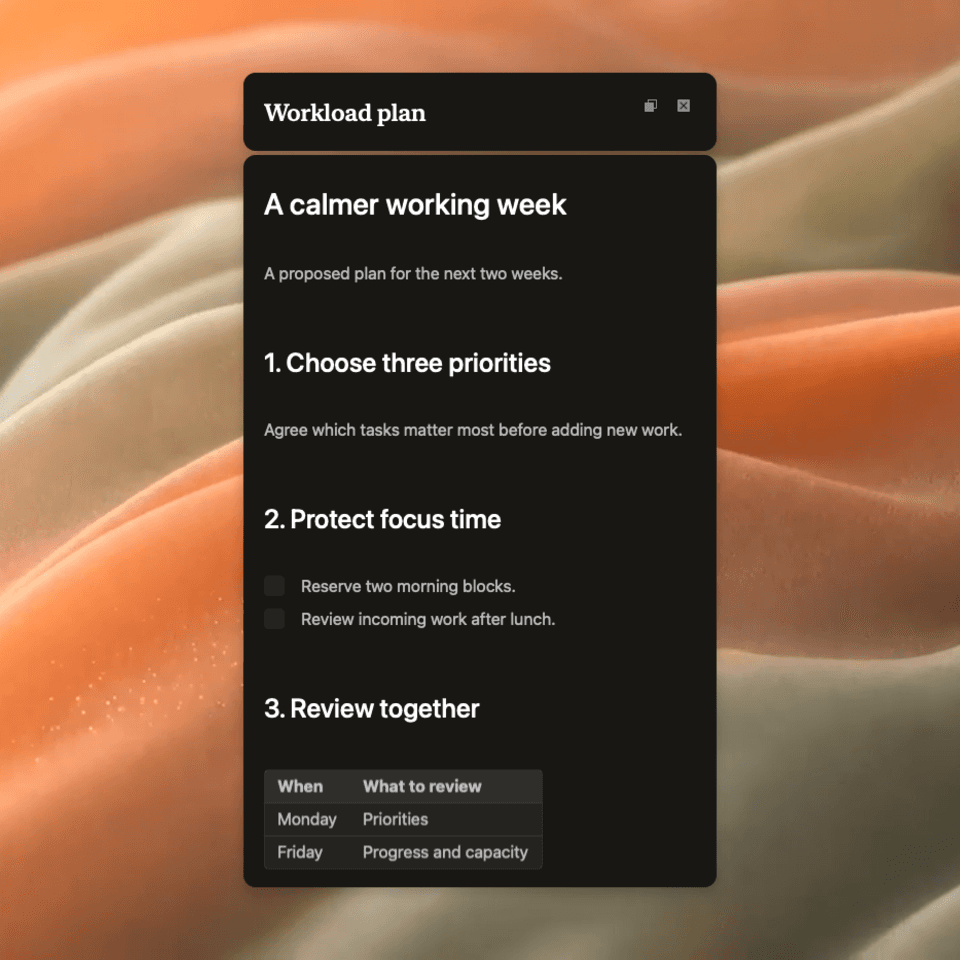
Native preview with synthetic demonstration content. It illustrates a reviewable plan, not an actual retrospective outcome or automatic task tracking.
Weeve offers local processing and optional external chat providers. When an external provider is selected, relevant context can leave the device for that request. Choose an appropriate mode for the information and the agreements under which it was collected. The Chat overview explains the product workflow.
Common mistakes to avoid with either method
Deciding the explanation before hearing the evidence. Write the question you are investigating before proposing the fix. Invite information that could change your view.
Confusing a repeated statement with repeated events. Several people can describe the same delay. Count distinct examples before describing a pattern.
Turning the review into a judgement of someone's character. Discuss the observable action, decision and conditions. “The approval was not requested until Thursday” is more useful to examine than “The team was careless.”
Recording every idea as an agreement. A suggestion, an objection and an accepted action are different outcomes. Check which one the notes describe.
Changing the name while leaving the question unclear. Calling a meeting a retrospective will not make a narrowly focused incident review broader or more participatory. Explain the scope and desired output in the invitation.
If the event requires a formal investigation or another established organisational process, use that process. A learning discussion should not be presented as a substitute for the responsibilities that process carries.
Make the choice before you schedule the meeting
Write one sentence stating what the review should help the team decide. If the sentence concerns a particular event and the difference between its plan and execution, start with an AAR. If it concerns how the team worked over a period and what to try next, start with a retrospective.
Then identify the evidence and people needed to answer that question. If those are missing, address the gap before adding another meeting. The useful outcome is a better-founded next action, with enough context to check whether it helped.