Lessons learned template: turn a project review into useful changes

Stefan Weiss

A useful lessons learned template records what happened, the evidence behind it, what to repeat or change, who will act and when the team will check the result. The document should help someone make a better choice on the next project. A list of everything that went wrong is only the starting point.
Below is a copyable template, a worked example and a practical way to turn meeting notes into a small set of improvements. Use it after a milestone, a delivery or a completed project. You do not need a large retrospective to capture one worthwhile lesson.
What belongs in a lessons learned record?
Separate the observation from your explanation. “The approval arrived after the planned release date” is an observation you can check. “The approver did not care” is an interpretation, and may be wrong. Your template needs room for that distinction.
Atlassian's lessons learned guidance describes a structured record of project experiences followed by recommendations, ownership and review. The template here adds an explicit evidence field and a test for whether the proposed change was useful.
Keep successes as well as problems. If an early prototype answered a difficult question, record the conditions that made it useful. “Keep prototyping” is too broad to guide another team; “show the approval flow to the person who signs it off before estimating implementation” is actionable.
Copy this lessons learned template
Start with the review context:
Project or milestone: [Name and scope]
Review date: [Date]
Period covered: [Start and end]
People contributing: [Names or roles]
Intended outcome: [What the project was meant to achieve]
Actual outcome: [What happened, with a link to the agreed delivery record]
Evidence available: [Meeting notes, recordings, issue history, delivery records]
Evidence missing: [Gaps that limit the review]
Then copy the following entry for each lesson:
Lesson [number]: [specific, useful title]
Observation: [What happened? Describe an event or behaviour without assigning motive.]
Evidence: [Source, date and relevant section or timestamp.]
Effect: [What changed as a result? Leave unmeasured effects unquantified.]
Contributing conditions: [What may explain the outcome? Separate confirmed facts from hypotheses.]
Repeat or change: [One practical recommendation.]
When this applies: [The situation in which another team should use it.]
Action owner: [Person who has accepted responsibility, or “unassigned”.]
Next step and due date: [A deliverable and an agreed date, or “to agree”.]
Review check: [What will show whether the change helped?]
Status: [Proposed, agreed, in progress, checked, or not adopted.]
Keep the full evidence nearby, but make the lesson itself short enough to read during planning. If one entry contains several unrelated changes, split it. If two entries propose the same change, combine them and retain both source links.
A worked example: an approval that arrived too late
This is a fictional example, not a customer result.
A team is preparing a new onboarding flow. It finishes the implementation before asking the operations lead to review the approval process. The review reveals that an exception needs an additional decision step.
Observation: The operations review took place after implementation had finished. The exception path then needed another review and a revision.
Evidence: The review meeting notes identify the missing step; the issue history shows when the revision was opened. Neither source measures the overall cost of the delay.
Contributing conditions: The plan named a final approver but did not include an earlier review of exceptions. Whether this was the only cause remains unconfirmed.
Recommendation: For the next workflow change, ask the operational approver to walk through a normal case and an exception before implementation begins.
Action: The project lead adds that review to the next kickoff checklist and asks the operations lead to confirm availability. Ownership and timing remain proposed until both agree.
Review check: At the next milestone, check whether the early review happened, which issues it found and whether the same exception was reopened later.
The record avoids claiming that one meeting would have prevented every problem. It identifies a concrete change the team can try and evidence it can inspect afterwards.
Run a review that produces usable lessons
Ask contributors to bring one success, one difficulty and a source for each before the discussion. This gives quieter participants another way to contribute and gives the facilitator something more specific than a general impression to work with.
Start by agreeing the scope: which milestone is being reviewed, what outcome was expected and what the discussion should produce. Use three passes through the material:
Establish the events. Put the important moments in order. Resolve factual differences where the records allow it; mark the others as disputed.
Explore explanations. Ask which constraints, dependencies or assumptions contributed. Do not treat the most confident explanation as a verified cause.
Choose changes. Agree a small set the team can realistically apply. Give each a proposed owner, a next step and a review check.
When feedback becomes personal, bring it back to an observable event: “Which approval was missing, and when did we discover that?” This preserves the useful concern without turning an assumption about someone into a permanent record.
If a recommendation is outside the team's authority, record who needs to decide. Do not label it agreed simply because everyone in the review would like it to happen.
Use meeting records to check the lesson
If the evidence is in recorded conversations, Weeve Chat can help you revisit your recording library and inspect linked summaries or transcripts. Treat the answer as a draft interpretation: open the source and check the wording, context and date before adding it to the lessons learned record.
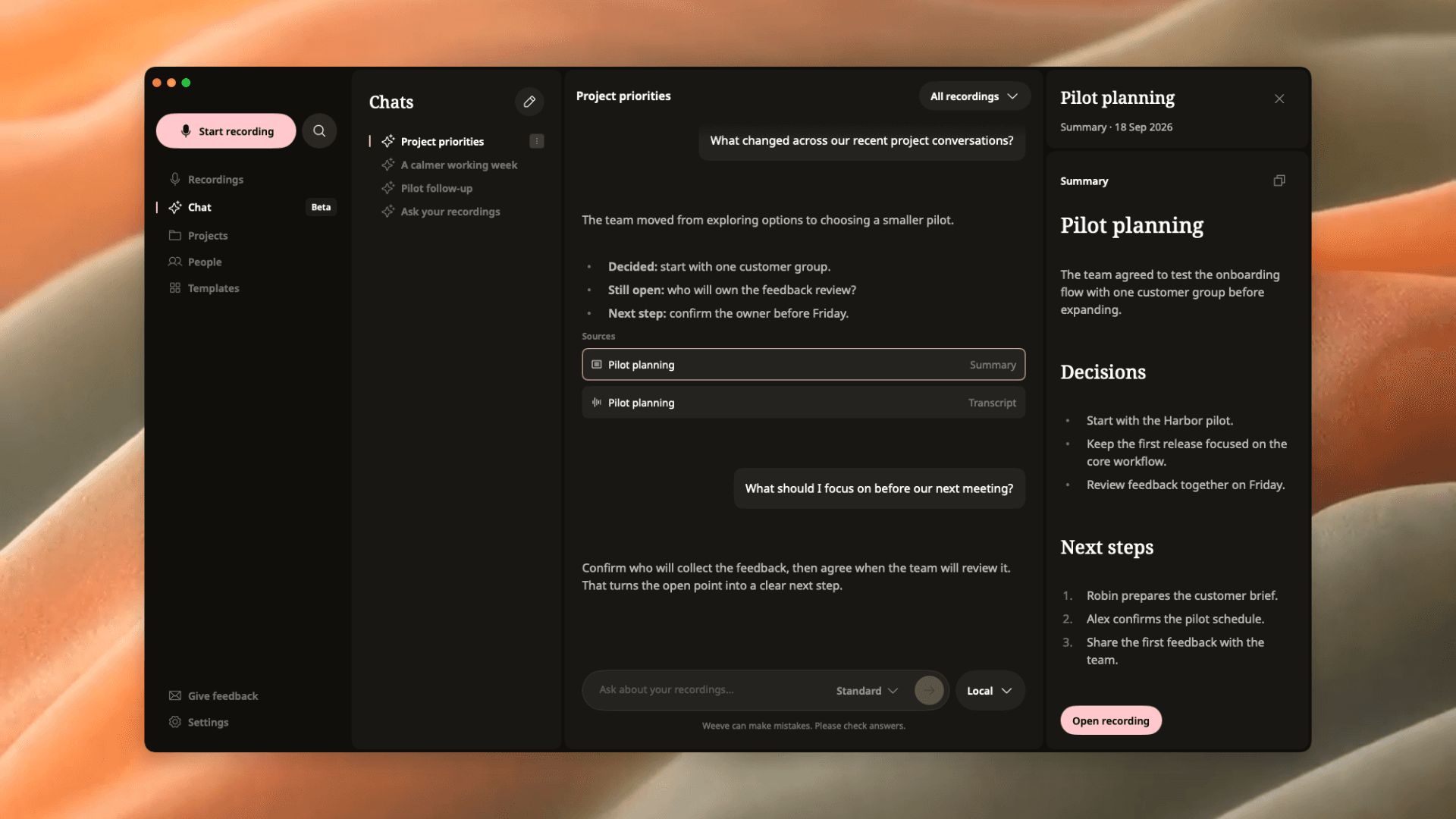
Native Weeve interface with demonstration content. The image illustrates source review, not the fictional project described above.
Start with one relevant recording, then review other known sources as needed. A useful prompt is:
From this recording, list the events that affected the project outcome. Separate observations from possible explanations. For each point, identify its supporting source. Flag missing evidence and do not invent owners, dates or agreement.
Follow up on one point at a time. A summary can help you find a topic, but the transcript may reveal that an apparent commitment was only a suggestion. An unanswered question in the available records is a gap to investigate, not proof that nobody considered it.
Weeve's Local mode keeps the Chat workflow on your Mac. Optional ChatGPT use has a different processing boundary; choose the mode appropriate for the material. Chat does not apply your process changes or update your team's task tracker. Transfer approved actions yourself and confirm them with their owners. The Chat workflow and limitations explain these boundaries.
Make the lesson available at the next decision

Store a lesson where someone will encounter it before repeating the work. For the approval example, that might be the kickoff checklist and the workflow-review agenda. A retrospective folder alone is unlikely to be the place the next project lead looks while planning.
Keep a lightweight lessons learned register with a title, applicable situation, owner, status and link to the full entry. Add the review outcome later: applied and useful, applied with mixed results, not yet tested, or not adopted with a reason. Writing a recommendation is not the same as testing it.
Use your normal action-item review to follow through. Once the action is complete, check whether it changed the outcome you cared about. A revised checklist is an output; evidence that the next project used it is a separate check.
Before closing the review, make sure every selected lesson has an identifiable event, supporting evidence, a clear boundary on what is known and a next step someone has accepted. That gives the next team something they can use, question and improve.