Voice journaling: how to keep an audio journal you can revisit

Dylan de Heer

Voice journaling means recording your own reflections instead of writing every entry. You can keep the recording, turn it into a transcript, or retain both. The useful choice is the one that lets you capture a thought comfortably and find it again when you need it.
Start with one ordinary question, speak for a few minutes, and give the entry a recognisable title. You do not need a polished delivery, a daily streak or an AI interpretation of everything you say. A small collection you understand is more useful than a growing archive you never open.
This guide explains the differences between audio journaling and dictation, how to organise entries, and how to review them without turning passing thoughts into firm conclusions.
What counts as a voice journal?
An audio journal is a series of spoken entries intended for your own later use. It might contain a reflection after work, an explanation of a decision, an idea you want to develop, or a record of something you noticed. The entries do not need to follow a single format.
The distinction from a loose voice memo is your intention. A memo might say “buy printer paper”. A journal entry might explore why a task was difficult, what you tried, and what you would change. Both can be worth keeping; neither needs to become a long essay.
There are three practical ways to make one:
Audio only: preserve the spoken entry and listen later. This keeps your delivery but makes browsing dependent on titles and playback.
Audio with a transcript: keep the recording alongside readable words. Search can help you locate passages, while audio remains available to check what you actually said.
Dictated text: speak into a writing app and keep the resulting text. This suits people who want a written journal without typing the first draft.
Choose deliberately. If you want to hear the original account, text alone will not provide it. If you only want a private paragraph to edit, retaining hours of audio may add work you do not need.
Is audio journaling better than writing?
It depends on what makes an entry easier to create and revisit. Speaking allows an unfinished thought to stay unfinished. Writing gives you more control over wording as you go. Audio also requires a place where you can speak comfortably; a notebook or text entry may be more practical in a shared room.
Try the same small topic in both forms. For example, describe a choice you made today, the reason for it, and one uncertainty. Then ask which version you would prefer to revisit next week. Judge the whole process, including retrieval, rather than only how quickly the first words appeared.
Real experiences vary. In a personal account of a month of audio journaling, Takuya Kitazawa described keeping entries short, but also noticing repetitive content and unclear next steps. That is one person's experience, not evidence that the same routine will suit everyone. It does suggest useful questions to test in your own approach. Read his original account.
You can combine formats. Record a rough reflection, then write a two-sentence note about what matters. Or type during the week and make a spoken recap when you have something to explore. There is no requirement to move your entire journal into one medium.
Decide what you want the journal to do
Before choosing an app or buying equipment, finish this sentence: “I want to be able to return to these entries when…”
Different answers lead to different habits:
When I need to remember an idea: use concrete topic titles and keep enough context to understand it later.
When I review a decision: say what you knew at the time, what you expected, and what remained uncertain.
When I want to notice recurring obstacles: include a specific situation and what happened, rather than only an overall judgement about the day.
When I begin writing: distinguish the raw spoken material from the edited piece you eventually create.
Avoid making every entry serve all four purposes. A journal can hold a question without producing an action. Conversely, if an entry contains an actual task, put that task somewhere you normally check. Recording an intention is not the same as scheduling or completing it.
Make a first entry that is easy to understand later
Choose a simple recording setup
A microphone you already have is a reasonable starting point. Make a short test in the place where you expect to record. Play it back and check that speech is understandable, the correct microphone was used, and the file or entry was saved where you expected.
Keep the recording environment consistent while you learn the workflow. If you change a headset, input device and room at the same time, a poor result becomes harder to diagnose. You do not need studio sound for a personal entry; you do need speech you can understand.
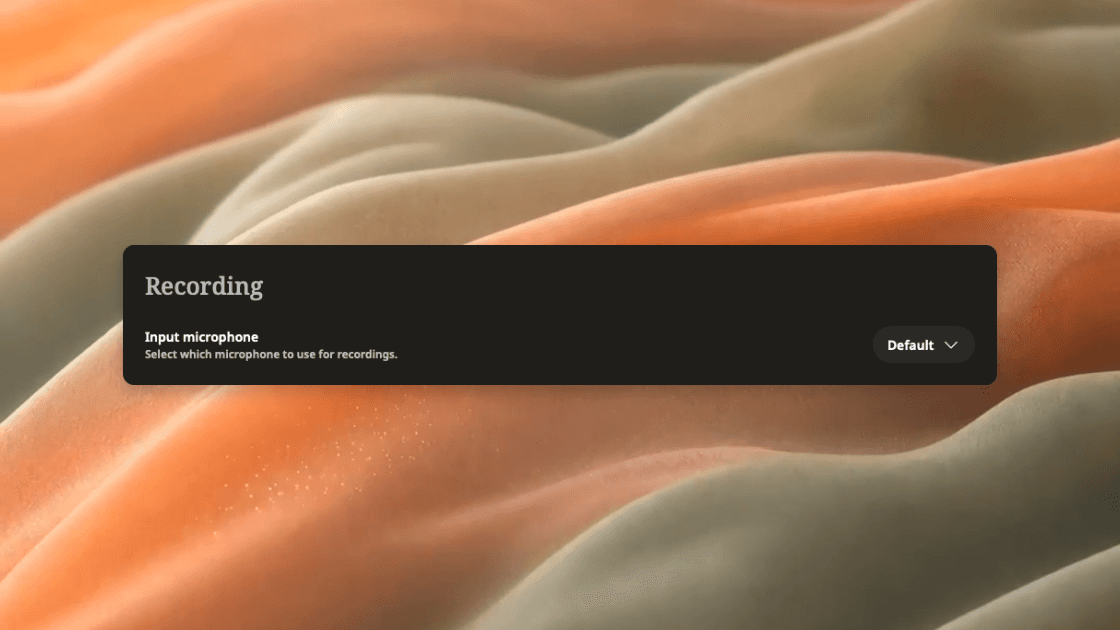
In Weeve, the recording preferences let you choose an input microphone. The screenshot below shows that control. The broader record-your-thoughts workflow keeps a spoken recording available for transcription and review. Use a short test before committing an entry you care about.
Start with one question
Pick a question with a clear boundary: “What made today's planning difficult?” is easier to revisit than “What is going on with everything?” State enough context that your future self can follow the answer without reconstructing the whole day.
A useful entry can cover the situation, your current view, and what you want to remember. These are prompts, not compulsory headings. If the thought takes thirty seconds, stop there. If it needs longer, continue without trying to meet an arbitrary duration target.
Use plain references. “The Tuesday design review about the sign-up screen” is more searchable and understandable than “that meeting earlier”. Avoid recording unnecessary details about other people when a neutral description will do.
Keep observations separate from interpretations
Consider this fictional entry:
In this morning's planning session, two estimates changed after we clarified the scope. I felt rushed because I had prepared the earlier figures. I think I need a clearer version of the brief before the next session. I do not yet know whether the problem was the brief or my preparation.
The entry preserves an event, a personal reaction, a possible explanation and an uncertainty. A later summary should not flatten it into “the team failed to prepare”. That would give a tentative interpretation more authority than the original account supports.
You do not need to analyse every sentence while speaking. Add a short clarification afterwards if something sounds more certain than you intended. Date the clarification so that a later change of mind does not erase your earlier view.
Organise entries for retrieval
Choose a naming pattern you can maintain. A date and a specific topic are usually sufficient: “22 October — preparing the revised project brief”. Use the same wording for recurring topics where practical, while avoiding vague titles such as “thoughts” for every recording.
Keep the organisation shallow. One place for journal entries and a few recognisable themes can be enough. A complex hierarchy creates another decision every time you record and may not help you locate anything.

If you use transcripts, correct errors that will affect retrieval or meaning. Names, project terms, dates and negations deserve attention. There is little value in polishing every filler word in a private reflection unless you intend to reuse the text.
Try a retrieval check after your first few entries: can you find a particular decision or idea without opening every recording? If not, improve the titles or add a short note. Solve that small problem before adding more automation.
Treat summaries as navigation aids. They can make an entry easier to scan, but the original recording and your own contextual notes matter when the distinction is important. If a transcript says “I will accept” where you said “I will not accept”, a fluent summary built from it may carry the error forward.
Review the journal without overinterpreting it
A review does not need to mean listening to every minute. Choose a bounded question and a small date range: “What did I say I needed before starting this project?” or “Which ideas from this week are still worth developing?”
For each useful passage, decide whether you want to keep it as context, act on it, ask a further question, or leave it alone. A reflection can remain a reflection. Do not turn every recorded concern into a task list.
When comparing entries, look for changes as well as repetitions. If Monday's entry says a plan feels unclear and Friday's says it now makes sense, both belong in the account. Counting mentions of “unclear” without their dates and context would miss the change.
Repeated entries are also a selective record: you may only record on difficult days or when an idea occurs. They are not a complete measurement of your work or life. Use them as material for reflection, not as a score or a diagnosis.
For recordings saved in Weeve, Chat with recordings can help explore stored material. Ask a narrow question, review the cited sources and check what recordings were included. A suggested connection is something to inspect; it is not proof that the app has understood the whole history.
Choose privacy and retention deliberately
Before recording personal material, check where the audio, transcript and backups live, which devices can access them, and what happens when you use an external AI service. A private intention does not make every storage or sharing choice private by default.
In Weeve, local transcription and local Chat process on the Mac. If you choose an external provider such as ChatGPT or Claude, relevant messages and source text are sent to that provider. Anonymisation can miss identifying details. Keep those choices in mind before asking an external service to analyse personal entries. See the recording-library workflow and its processing boundaries.
Decide what you need to retain. Some entries may deserve audio and text; others may only need a short note. Before deleting an original you care about, check that the copy or export you intend to keep actually opens and contains the material you need.
When sharing an idea from a journal, create a separate reviewed excerpt. A whole entry may include unrelated names, unfinished opinions or context the recipient does not need. Do not assume that removing a name removes every identifying detail.
Common reasons the habit becomes awkward
You feel self-conscious speaking. Start with a concrete description of something you did, rather than a polished monologue. A brief text entry is also a valid choice when speaking is uncomfortable or impractical.
Every entry sounds the same. Change the question. Ask what changed, what surprised you, or which assumption needs checking. If nothing needs recording, there is no need to invent an entry to maintain a streak.
You never listen back. Decide whether capture alone serves your purpose. If retrieval matters, add a useful title and a short written takeaway rather than committing to replaying everything.
The transcript looks messy. Fix meaning first. If the aim is a readable written journal, dictated text with a short editing pass may fit better than storing a verbatim account. The dictation-versus-typing guide explains that broader drafting choice.
AI gives the entry a stronger meaning than you intended. Return to the source. Restore qualifiers, separate your views from someone else's words, and remove conclusions you cannot support. You can keep a journal without asking AI to interpret it at all.
A small first experiment
Make three entries on different days using the same simple setup. Give each a specific title, then try to retrieve one detail from each. Keep whichever parts helped and change whichever parts added friction.
That gives you something concrete to evaluate: whether you can capture a thought, understand it later and decide what to do with it. Build the routine around those results rather than the size of the archive.